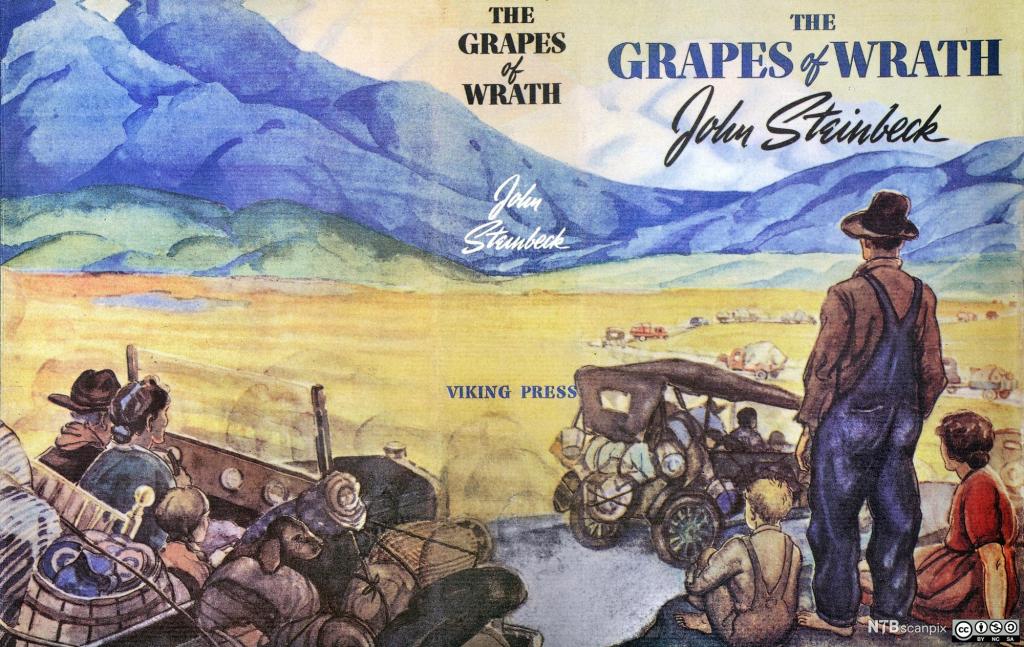
Short Blog- Grapes of Wrath Cover Analysis

One night I left my copy of The Grapes of Wrath at home. Not wanting to fall behind in the reading, I scoured the internet for a pdf copy. Luckily, quite a few were publicly available, including one with the cover above. Immediately, I was intrigued. The cover appealed to me in a way that our hard copy’s didn’t. After a few minutes of research, I discovered that this was the cover originally pictured on the novel’s first publication.

Immediately I was drawn to the Joads, who are pictured front and center. Their vehicle, which is clearly overpacked, appears to be headed west, out of the plains and to the mountains. It’s clear that they’re peering towards these mountains, and while the Joads are the only visible characters on the cover, the sheer amount of other cars headed in the same direction convey that their sentiment is not unique. This foreshadows the events of the novel and mirrors real life, as the camps the Joads ended up at were crowded and work was scarce. Their looks toward the valley convey a feeling of hope as they take a leap of faith that there is a better life on the other side of the mountains. While that ultimately isn’t the case, the idea of abandoning everything out of sheer hope encapsulates the concept of the American Dream. 

I like this cover a lot more than the version on the copy our class received, simply because the details do a much better job of conveying the essence of the Grapes of Wrath. Ultimately, the novel is about hope and desperation- moving to a new place out of a lack of options, having faith that their lives would be better. It’s this hope that is encapsulated in the cover.

Hollywood in the Great Depression

As I was reading The Day of the Locust, I wanted to know more about Hollywood and how it survived the Great Depression. What I found shocked me and proved to me that film is a universal art form that nearly everyone can participate in today and apparently in the past.

On average, 60-80 million Americans went to the movies during the Great Depression era. People saw Hollywood’s movies told stories of gangsters and politicians, monsters coming alive and grand adventures to foreign world’s. Cinema helped people cope with the the Great Depression’s hardships and told some of the world’s greatest stories. Some movies that released during the Depression era were Wizard of Oz (1939), Frankenstein (1931), A Star is Born (1937) and Gone With the Wind (1939). These movies are classics that have been watched millions of times over and over since their release and highlight the Golden Era of Hollywood. But why were these movies so important?

Hollywood provided an escape from reality for those who were bruised and beaten by the Depression for only 25 cents. Granted that would be worth $4.98 on March 10, 2020 but apparently everyone could afford that. The average movie cost around 1.5 million dollars to produce and movies like Wizard of Oz cost almost double that and the return was incredible. Wizard of Oz made 26.1 million dollars (nearly 500 million dollars in today’s money) during its run in theaters.

Clearly Hollywood and the movies that it produced were important to people during the Depression as millions of people still went to see movies during the depression. The importance of movies is still seen today as movies make 100s of millions of dollars in their first three days and I cannot see how Hollywood and films could ever slow down in popularity and production.

Image result for wizard of oz theater sign 1930's

Short Blog- Farewell To Arms

Due to the disturbing ending of farewell to arms I came to the realization that this book was full of traumatic events that shaped who Patrick Henry was. While reading this book, I personally felt that Patrick Henry did not change to the extent that the readers would have expected. I had always felt Henry’s sense of selfishness throughout the novel but never really understood it until the end. In my opinion all these negative experiences lead Henry to believe the worst and therefore he does not allow himself to fully feel. He is numb but in a sense wakes up in the slightest about as Cathrine and his child die. This novel was complex and allowed the readers to think deeper than the surface but overall I did not enjoy the novel very much and felt that it was super long.

Short Blog- Grapes of Wrath

This book was extremely interesting and I actually enjoyed it more than I thought I would. I really resonated with the fact that the family survived together through hope and determination to stay in contact. During the discussion it really stood out to me how much the characters developed throughout the novel. I was especially shocked by this because going into the discussion my main question had been” do you think Tom has changed throughout the novel?.” The responses to this questions were similar to my opinion but it also allowed for more conversation about others growing. Ma grew an exponential amount during this novel as well and that is show at the end of the novel as she is saying goodbye to Tom. Ma always attempts to keep the family as closely knit as possible but in this instance, she is aware that Tom must leave and regardless of that, they will always be family and stay close. Overall, the Grapes of Wrath was a very interesting and intriguing novel and I enjoyed reading it.

Short Blog #2

If you think everyone works in Silicon Valley in the 1930s, that’s absolutely incorrect. People underwent tremendous pain under the Dust Bowl. In the book The Grapes of Wrath, Steinbeck closely depicted the scene of California farm workers as a part of the immigrant family.

In Chapter 17 and 19, the quote of “They were not farm men any more, but migrant men” and “They were hungry and they were fierce. And they had hoped to find a home, and they found only hatred,” both quotes revealed the social status of the farm workers, they’re excluded, abandoned from the local life. They had hoped to find regular work even if only paid with the minimum wage, rent a house to live, and continue the good life. Instead, they perceived that all the Californians hated them because they were labeled as the “stealer” of their job, in which once they get hired, the owners will lose the job and may end up with homeless. The migrant workers were tentatively “moved” from the Great Plains due to the extreme sacristy of food, water, and love.

The novel depicts the elegant attitude towards the immigrants no matter which state they are moved from. Natural disasters are unavoidable and are potentially alter a person both physically and mentally. Nobody naturally born evil so why we could treat them differently?

When the nation faces a serious problem, it’s also the time for everyone connect the heart together, to collaborate, to survive the setback period. People with negative attitude will transfer the emotion, the bad emotion will merely accelerate the deterioration. Everyone has the responsibility to solve the problem, until the new life starts.

Short Blog – 1

I thought Hoovervilles were an interesting thing that happened during the Great Depression. I like the humor in naming them after President Hoover who is seemingly responsible for getting these families into this sticky situation. It’s cool how each Hooverville was its own community. Each Hooverville would have its own set of unwritten rules that everyone would have to follow and nobody had an issue with these rules. Everyone who lived in these towns looked out for each other as best as they could like when Ma gave the hungry children the little bit of leftovers because she felt bad. It is interesting to see the resourcefulness of the people in these towns. They were making homes out of anything and everything. They would create their homes out of old metal, box cars, tarps, sometimes cardboard, and much worse. I think it shows the perseverance of the people of that time and how they just had to survive.

Traditional Roles Reversed

In John Steinbeck’s “The Grapes of Wrath”, the women do not take on a role that they normally would in the time period. During this time period, women were supposed to be the traditional house wife. The text makes it apparent that traditionally the husband was the head of the family and had a majority of the say: “Why, we’d be proud to have you. ‘Course I can’t say right now; Pa says all the men’ll talk,” (127). As the Joad’s try to make it through their struggles, Ma assumes the position that a man would take. For example, when the car breaks down Ma is the one to make the decision on what the family does: “You win, Ma… Pa, you jus’ got set back on your heels,” (232). Throughout the novel, Ma continues to make a majority of the decisions and lead the family. Besides Ma having the more traditional role of a man, Pa also takes the role of the traditional women. In the text, it is shown that women are meant to do housework. As the Joads are getting ready to leave, Casy offers to do some of the cooking, but Ma says “It’s women’s work,” (146). By the end of the novel, Pa is doing this work by making a meal: “Ma watched him sullenly while he chopped out part of the inner wall of the car, built a fire, and scooped water into the pan,” (613). It is evident that in “The Grapes of Wrath” the Joads do not take on the traditional roles of the time period.

How It Feels To Be an Okie

Something that stood out to me throughout the book “Grapes of Wrath” by John Steinbeck is how similar the Okies are treated in comparison to African Americans at the time. There are so many similarities that stand out to me between them- how the Okies pick cotton as slaves used to do, how the threat of lynching applies to people who disobey the rules like lynching was often used as a punishment for slaves, especially escaped ones, and how the the Okies are hated by everyone. Even the word okie has become derogatory towards them like the derogatory names used towards African Americans. Steinbeck’s intention must have been to make this very evident, because by comparing the treatment of the Okies to the treatment of African Americans he truly emphasizes how badly they were treated. Going even further, we get a insight to how the Joad’s treatment affects them psychologically throughout the novel. The differences in the two camps, the Weedpatch with human treatment versus the non government camps with inhumane treatment affects Ma deeply, and she rejoices when she is finally treated with decency in the Weedpatch camp. She even then claims that “These folks is our folks – is our folks” (420). By doing all of these things, Steinbeck can truly make the audience feel how the Joads are feeling for the duration of the novel.

Resources for The Grapes of Wrath

About the Author

Born in 1902, John Steinbeck, author of The Grapes of Wrath, became a Nobel and Pulitzer Prize-winning American novelist. This source contains information about his life, including his childhood, education, and writing career.

https://www.biography.com/writer/john-steinbeck

Historical Context

Set during the Great Depression era of the 1930s, The Grapes of Wrath encounters the struggles of the American people who were affected by the Dust Bowl. This source provides information about this impactful historical event and what it meant for the many families who were forced to leave their homes.

https://www.britannica.com/place/Dust-Bowl

Controversy in Kern County

At the end of the book, the Joad family ends up in Kern County, California. After the book was released, there was a lot of controversy that surrounded it, especially in Kern County. The book was banned for a year and a half. This article talks about why the book was banned and why the residents of Kern County objected against the novel.

https://www.csmonitor.com/Books/chapter-and-verse/2014/0227/John-Steinbeck-s-The-Grapes-of-Wrath-wasn-t-so-beloved-by-one-California-county

The Grapes of Wrath becomes a Film

The Grapes of Wrath directed by John Ford, appeared on the big screen in 1940. This movie is considered to be one of the greatest American films of all time. Because of it cultural and historical significance, the film was chosen by the Library of Congress to be preserved by the U.S. National Film Registry.

https://www.britannica.com/topic/The-Grapes-of-Wrath-film-1940

1ST SHORT BLOG

Grapes of Wrath chapters 13-15

Throughout The Grapes of Wrath, and especially chapters 13-15 death and depression have been a common theme. While the Joads family rests their dog is hit by a car. A quote on page 177 “And the dog, a blot of blood and tangled, burst intestines, kicked slowly in the road” this quote explains how the dog was hit by the car and that it was gruesome. It also says “The big car slowed for a moment and faces looked back, and then it gathered greater speed and disappeared” in chapter 13. This shows how people just treated each other poorly and everyone is only looking out for themselves. The Joads Grandpa also dies in this chapter, he dies by “A good quick stroke” says Casy. Even with the death of Grandpa and the dog the Joads and the Wilsons still find away to be thankful and proud for what each family has done for each other. “Pa said, We’re thankful to you folks.” “We’re proud to help, said Wilson”. Whats interesting to me is how multiple times in the book people treat each other with no respect, granted the Joads Grandpa just died, but the Wilsons offered a tent and their respect to the Joads.

Design a site like this with WordPress.com
Get started