“No Country for Old Men” by Cormac McCarthy, is an action packed novel, never once boring its audience. The novel immediately begins with action, when Chigurh escapes the sheriff and proceeds to kill him and take his car, and then immediately killing someone else. It is quite shocking, and as the novel progresses we see more of Chigurh’s character and how bad of a man he truly is. It seems that he kills people with no reasoning, and that he doesn’t feel bad at all when he does so. For example, after Llewelyn dies, Chigurh still decides to kill Llewelyn’s wife, Carla Ann, because Llewelyn didn’t directly give him the money. Chigurh still managed to find the money, so normally he would let the wife live, but he doesn’t. He is such a bad man, and he somehow manages to escape for good and never be seen again. He doesn’t have any punishment for the mass murders he committed, and this is quite a depressing ending. The novel was very entertaining, and even though it doesn’t end the way the audience it wants to, the ending alludes to the fact that in life not every bad action is punished, and not every criminal is captured.
Tom Joad vs. Sheriff Bell
The Grapes of Wrath main character Tom Joad could not be more different than No Country for Old Men’sSheriff Bell. Tom Joad is not the perfect citizen. The book opens with the reader learning he just got out of prison for murder: “ ‘Homicide,’ he said quickly. ‘That’s a big word – means I killed a guy’ ” (18-19). On the contrary, Sheriff Bell could be seen as a model citizen. He is a sheriff and was awarded in the army: “I was just back from the war. I had some medals and stuff” (50). Even though Sheriff Bell appears good on the surface and Tom Joad appears bad, they qualities they possess says otherwise. While Sheriff Bell is by no means a “bad guy”, he does not actively try to do good, while Tom Joad works to better himself and the world around him. For example, Sheriff Bell did not get his war medal for a very heroic reason: “I was supposed to be a war hero and I lost a whole squad of men. Got decorated for it” (116). Sheriff Bell also gives up in the end of the novel. He retires before he could get the problem under control: “It was defeat. It was being beaten” (183). On the contrary, Tom Joad tried to spark change: “Wherever they’s a fight so hungry people can eat, I’ll be there” (572).
The awakening- Edna
I was most interested in the character of Edna and her mannerisms. I found her dissatisfaction in being a wife and mother very interesting but also intriguing. It is obviously something that is extremely difficult to do but it is a reality for many people I feel like. Edna clearly has many internal struggles and portrayed those in a very interesting way. It is astonishing to see her identity form as she changes and begins to perform disturbing acts. Ednas character is intune with the name of the book as Edna is discovering herself in a whole new light as she begins to turn away from the responsibilities of her previous life.
Short Blog #4
Throughout Puddn’head Wilson, fingerprint identification plays a pivotal role in the progression of the plot. Puddn’head offers to take the fingerprints of Tom and Chambers, who are later switched by Chambers’ mom Roxy. This fingerprint identification is the only link to the two boys’ true identities. Since the novel was written in 1894, I was interested to see how long this technology had been out for at the time of the novel’s publishing.
Here is what I found:
Fingerprints weren’t used as a method of identification until the 19th century. Sir William Herschel, a Chief Magistrate in India (which was a British colony at the time), started making residents record their fingerprints when signing documents.
The first major breakthrough on the front of criminal investigation didn’t come until 1892, just two years before Puddn’head Wilson was published. Juan Vucetich, a police officer in Buenos Aires, was called to a crime scene and was able to successfully match the fingerprints at the scene to a suspect involved. This set a framework for investigation methods that are still being used to this day.
While this history was brief, I just found it interesting that Twain was discussing a topic that was incredibly current and rapidly changing.
The Not-so Motherly Edna Pontellier
Throughout the novel “The Awakening” by Kate Chopin, the main character, Edna Pontellier tries to escape her motherly responsibilities. Edna is very unlike most of other mothers, in general, and in the novel there is a large contrast between Edna and her friend Adele, who is the perfect mother and woman in that time period. A quote that stood out to me in the novel and that I think perfectly represents Edna as a mother is the quote where she describes her children “as antagonists who had overcome her; who had overpowered and sought to drag her into the soul’s slavery for the rest of her days” (384). This quote is at the end of the novel, right before Edna decides to commit suicide, implying that a large portion of the reason that Edna did this was to escape her children and her motherly responsibilities. Hearing this quote from anyone other than Edna would have greatly shocked me, but because the audience can tell throughout the entire novel that Edna does not like being a mother, it is not quite as surprising. Edna seems to think that committing suicide is the best option for her children, and so maybe her last act could be seen as her being a good mother, but I’m not so sure about that.
Context of No Country for Old Men
No Country for Old Men takes place in the 1980s on the United States/Mexico border. Leading up to this time period, drugs were identified as a threat to the nation. On July 14th, 1969, President Nixon told congress drugs were a serious threat and they needed to take action. In June 1971, Nixon declared a “war on drugs”. As time goes on, the war on drugs in not won. In the early 1980s, the main drug trafficking route was through Florida. To combat this, Florida creates a South Florida Drug Task Force. Because of the task force, cocaine trafficking transport routes are changed. In the mid-1980s, the Mexican border is the major route for drug trafficking. In the early 1980s, the first form of crack is developed. Crack becomes very popular in New York. The main route of transfer for cocaine is over the Mexican border. Smuggling drugs over the border was a bloody task. Trading drugs went hand in hand with violence. In the 1980s, the main drug cartel was Pablo Escobar’s Medellin drug cartel. The cartel was extremely powerful and known to be very violent. When the violence was the worst, a hundred police officers were killed in a month.
Sources:
https://www.npr.org/templates/story/story.php?storyId=9252490
https://www.encyclopedia.com/arts/educational-magazines/no-country-old-men#his
Lyke Puddn’head Wilson Short Blog
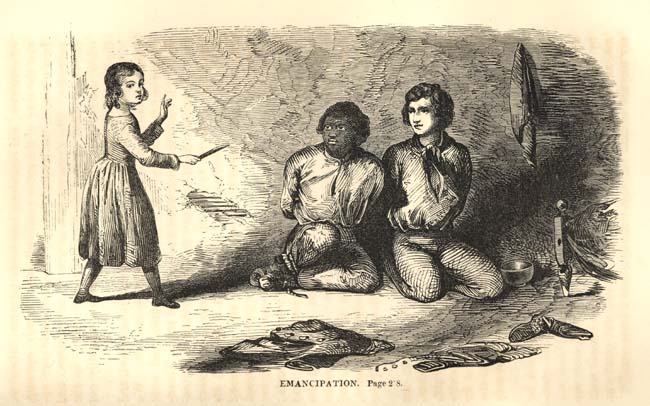
This art depicts a black and a white slave sitting side by side with what looks like a little white girl as their master. This is relevant to Puddn’head Wilson because in the novel, the only reason the babies are switched is because one is bound to be a slave by the one drop rule. The one drop rule states that if you have one drop of slave blood then you are a slave. The baby boys were so similar that nobody could tell the difference when they were switched and the slave ended growing up and acting the part of a slave owner and the slave owner ended up growing up and acting the part of a slave. This concept completely breaks down the whole premise of slavery which is that one race is superior than another. The art above shows how weak the premises of slavery actually are and when the whole concept of race being the divider breaks down because slaves are mixed race, there is going to be a change. This wasn’t the whole reason for the civil war. People just realized that slavery in general is wrong, but I think it could have been a factor in getting some people to realize why slavery is wrong.
Puddn’Head Wilson
The central action that drives every event in the novel Puddn’head Wilson comes from the switching of the two babies by Roxy. The only reason that the babies could be switched without anyone noticing is because of how similar the two babies looked. Despite their appearance, one boy is considered black and one is considered white. The point Twain was trying to drive home is that there is little that seperates people who are black and white. The two boys only look alike for the novel to make sense logically, had Chambers looked more black but had been switched anyways he still would’ve ended up the same way. He’s trying to say that people are not products of their race as much as the way they grow up. My interpretation of Twain’s writing leads me to believe that all races are equal but that Collins’ (or the fake Tom I guess) plight was due to the faults in his upbringing and his personality. He may have simply been born an arrogant and selfish person but his life of luxury definitely helped nurture his faults. The real Tom on the other hand has become a meek slave who cannot handle having his birthright thrust upon him. He may have been destined to live Collins’ life due to being white, but he can’t handle it due to his life up to that moment. His experiences had molded him into something else, even if his race had dictated he take his birthright.
Aidan Lee-Gilligan
Symbols in The Awakening
In The Awakening by Kate Chopin, there are many symbols that represent Edna’s transition and carry out the messages of the novel.
Birds: The novel begins with a parrot repeating this phrase: “allez vous-en! allez vous-en! sapristi!” At this point, readers don’t know the significance of this parrot that represents Edna’s struggle with society. The parrot and Edna are both cadged and misunderstood. Edna is trapped by society just like the bird in its cage. Mademoiselle Reisz tells Edna, “The bird that would soar above the level plain of tradition and prejudice must have strong wings.” This quote shows the connection between birds and how they reflect the strength that Edna needs to defy the standards of society.
Sea: The sea represents one half of Edna’s “dual life.” She is trapped by society who is trying to conform, but in the sea she discovers her own inner strength that wants to defy society. In chapter six it says, “the voice of the sea speaks to the soul” (34). This is true for Edna as the sea symbolizes her freedom and the ability to reinvent herself. As we know, water is used for Baptism that symbolizes purification and rebirth. This is similar to when Edna enters the sea and becomes a new woman.
Houses: Edna stays in many different houses throughout the novel. In the first house, she is trapped and it serves as a cage. In each house she moves to, it is a symbol of her progression throughout the novel. She finds a different role for herself in each house. However, in the end she realizes that she will always feel trapped at home, no matter where she goes.
Cigars: Edna’s husband and Mr. Pontellier are constantly smoking. In the nineteenth century, this was a common practice for men but not for women. In the novel, cigars represent the dominant male nature in society at the time. It represents the things that Edna struggles to defeat.
Short Blog #7 (The Awakening)
The Awakening was a really good book. I liked the plot line and the character development, as well as its connection to American content. The main character was an interesting character since she had some care for her children, but not enough where she would follow them everywhere or die for them if they were in danger. I thought this to be very unusual in a mother since I have read and seen mothers who are very protective of their children. For this character, however, she would have servants take care of the children. Another thing I found unusual is that if one of the children injures themselves while playing, they don’t run to their mother, they instead brush themselves off and wipe the tears away before continuing to play. Ever since the character swam in the ocean at Grand Isle, I saw her personality change a lot from being this quiet, soulless woman to this person who pursues to find her inner self while avoiding her husband and children, acting selfish in a way. I also see her lusting after the older son of Madame LeBrun when he leaves for Mexico. While Robert LeBrun was in Mexico, Edna sort of falls in love with Alcée Arobin. When Robert comes back from Mexico, however, Edna falls in love with Robert, sort of forgetting her sort of affair with Alcée Arobin. What surprised me is that Edna’s husband didn’t know any of this. Overall, I thought that this was a really good, yet interesting book. I really liked all the characters, they had their own unique personalities and backgrounds.
 Great American Novels 2020